Basic HTML Version


1
1. Objectives
The goals of these tests were to determine the extent to which there may be asymmetrical
facility effects on live zooplankton and phytoplankton in ballast water treatment system testing
onboard the Maritime Administration vessel M/V
Cape Washington
and to determine if the test
facility itself is a significant source of mortality, or loss, during treatment system evaluations.
2. Basic MERC Test Facility Design
The fundamental approach of Maritime
Environmental Resource Center (MERC,
www.maritime-enviro.org) is to conduct
independent, scientifically-sound, rigorous, and
quality assured evaluations of ballast water
treatment systems. Specific protocols employed
are based on the IMO G8 guidelines for land-
based testing and the US Coast Guard supported
ETV protocols under development. MERC is
currently evaluating the biological and
mechanical efficacy of ballast water treatment
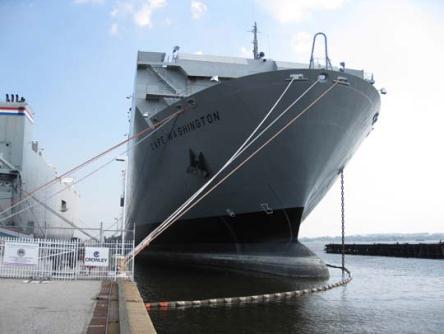
systems onboard the MARAD vessel M/V
Cape Washington
, while docked in the Port of
Baltimore (right). The ballast system of the
Cape Washington
has been modified to allow for
water at a flow rate of 400m
3
/hr to be split equally, and delivered simultaneously, to a “control”
(untreated) ballast tank and a “test” (passing first through the treatment system) ballast tank, each
at 200m
3
/hr (see page 7). The ship’s ballast tanks that are used for the required holding time of
five days are essentially identical in size (~ 650 m
3
) and structure. Treatment system
performance is evaluated in five to six replicate test trials. For each trial, the control and test
tanks are filled to between 250 and 400 m
3
(approximately equal volumes in pair control and test
tanks). The ballast tanks are also drained and manually rinsed/cleaned prior to conducting the
first evaluation trial, rinsed/flushed with approximately 20 m
3
of potable water, and drained
completely between trials for the last two conducted, to avoid the possibility of residual live
organisms in the bottom of the empty test tank influencing results.
For each ballast water treatment test trial, five sequential samples are taken for each of
the following: (A) initial/intake conditions, just prior to the split of control and treated water, (B)
initial conditions just downstream of the treatment system during filling of test tank, (C) control
water upon discharge after a five-day holding time, and (D) treated water upon discharge after a
five-day holding time (see page 8). Sample volumes and details of the physical, chemical, and
biological analyses for each sample are described below in MERC Test Plans available at
www.maritime-enviro.org.