Basic HTML Version


3
3. MERC Test Facility Validation Methods
On May 12, 13, and 14, 2009, three individual validation trials were performed (one per
day). Each trial involved simultaneously sampling of initial ballast water being brought onboard
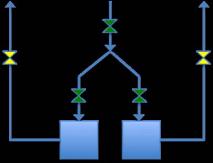
the vessel and split ballast water streams entering and being discharged from the two separate
ballast tanks used in routine tests (Figure 1). Sampling procedures were identical to those used
in treatment testing (as above), except treatments were identical in these validation tests and
ballast treatment system was deployed for the “treated” tank. The goal was to determine if ship
and test facility piping, valves, flow-regime, sample port, and tank create differences in the
numbers of organisms between sampling ports and/or ballast tanks designated as control and
treated.
Figure 1. A simplified schematic of the
validation testing. Water was collected
simultaneously from the three green sample
ports during filling and, one hour later, from
the two yellow sample ports during ballast
discharge. T = treated and C = control.
For each of the three replicate validation trials (May 12, May 13, and May 14), a total of
15 samples (1 m
3
each) were collected, including 3 replicates at each of the 5 steps or “ports” of
the fill and discharge cycle (Figure 1). Phytoplankton samples consisted of 1 liter samples of
unfiltered water, and zooplankton (> 50 µ m in size) were collected from remaining sample
volume by sieving, using the ‘soft-capture’ sieving method (described in MERC Test Plans).
While ballast tanks filled simultaneously with harbor water, 1 m
3
samples were taken
from each of three ports at: (a) the start of filling, (b) mid-point of filling, and (c) shortly before
completion (over approximately 1 hour). A sample port labeled Y-fill was located before the
ballast stream was divided between port (normally the treated side) and starboard (normally the
control side) tanks. A second port labeled C-fill was located near the point the ballast stream
entered the Starboard tank. The third port labeled T-fill sampled the ballast stream just before it
entered the port tank, normally filled with treated ballast water during trials of ballast water
treatment systems. After a 1 hour holding time, both tanks were discharged one after the other in
the span of about 1.5 hours, and 1 m
3
samples were obtained from a fourth sample port at the
beginning, middle, and near the end of discharging either tank.
Y-fill
C-fill
T-fill
C-dis
T-dis
C
T